• Artificial Intelligence - Financial Forensics - Litigation Consulting - QuickRead Top Story

    AI, Work Product, and Rule 26 In Three Cases

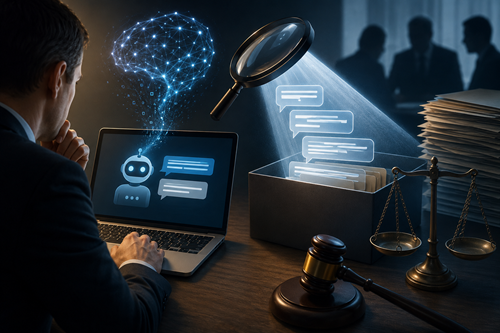
    Beware of Your AI Queries; They May Not Be Protected When you are a party in a legal matter, sometimes the things you type into an LLM are protected and sometimes they are not. Sometimes, if you share privileged things with your AI-companion, those things are no longer privileged. It depends on what you shared, who you are, and why you shared it. In this article, the author discusses three recent cases that discuss what is discoverable. Three recent cases have addressed the use of large language models (LLM or colloquially referred to as “AI”) in litigation: Warner v. Gilbarco,…

  • Financial Forensics - Litigation Consulting - QuickRead Top Story - Valuation/Appraisal

    A Collision Course in Evidentiary Standards for AI-Assisted Financial Forensics

    How a New Proposed Rule of Evidence Seeks to Admit AI Analysis and Supplant Experts On January 30, 2026, Anthropic released legal plugins for its Claude AI that automate contract review, compliance tracking, and legal analysis. Within three days, $285 billion in market value evaporated from legal software and publishing companies. This was not a correction. It was a signal. The AI companies are no longer content selling infrastructure, now they are coming for the legal, financial, and forensic analysis applications themselves. The author discusses the legal and practical repercussions that the new Federal Rule of Evidence would have on…

  • Financial Forensics - Litigation Consulting - QuickRead Top Story

    Reducing Privacy Fine Exposure on the Cheap

    (With the Help of ChatGPT) In this article, the author provides three versions of a data retention policy that appears compliant with GDPR or NIST. After taking NACVA’s cybersecurity course, a student reached out to me asking for a Data Retention Policy template that would be compliant with the statutes and frameworks discussed in the course, such as the National Institute for Standards and Technology (NIST) Cybersecurity Framework or the EU’s General Data Protection Regulation (GDPR). I thought this may be a good question for large language models because the subject matter is old enough that there is a sufficiently…

  • Practice Management - QuickRead Top Story

    Should AI be Disclosed?

    Recognize Ethical and Professional Standards of Using AI AI is pervasive and promises to fundamentally transform business operations, education, and daily life. However, functional insights bridging the gap between AI and our industry have been lacking. The authors share their views on the ethical and professional standards implicated from the use of AI in forensics and valuation engagements. This article explores the need for, or lack thereof, to disclose the use of artificial intelligence (AI) technology in the fields of business valuation and financial forensics. AI is pervasive and promises to fundamentally transform business operations, education, and daily life. However,…