• Artificial Intelligence - Financial Forensics - Litigation Consulting - QuickRead Top Story

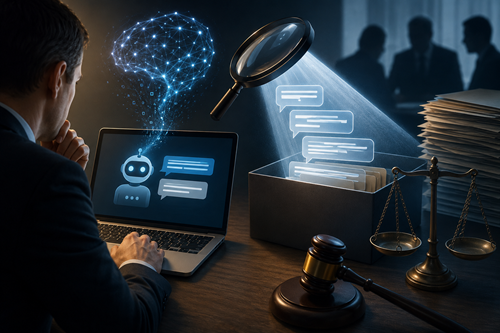
    AI, Work Product, and Rule 26 In Three Cases

    Beware of Your AI Queries; They May Not Be Protected When you are a party in a legal matter, sometimes the things you type into an LLM are protected and sometimes they are not. Sometimes, if you share privileged things with your AI-companion, those things are no longer privileged. It depends on what you shared, who you are, and why you shared it. In this article, the author discusses three recent cases that discuss what is discoverable. Three recent cases have addressed the use of large language models (LLM or colloquially referred to as “AI”) in litigation: Warner v. Gilbarco,…

  • Financial Forensics - Litigation Consulting - QuickRead Top Story - Valuation/Appraisal

    A Collision Course in Evidentiary Standards for AI-Assisted Financial Forensics

    How a New Proposed Rule of Evidence Seeks to Admit AI Analysis and Supplant Experts On January 30, 2026, Anthropic released legal plugins for its Claude AI that automate contract review, compliance tracking, and legal analysis. Within three days, $285 billion in market value evaporated from legal software and publishing companies. This was not a correction. It was a signal. The AI companies are no longer content selling infrastructure, now they are coming for the legal, financial, and forensic analysis applications themselves. The author discusses the legal and practical repercussions that the new Federal Rule of Evidence would have on…

  • Financial Forensics - QuickRead Top Story - Valuation/Appraisal

    The January Hangover

    A 10-Day Fraud Detection Sprint That Protects Business Value It is important to not only establish next steps but attempt to blur the line between fraud-driven forensic investigations and valuation to provide the connective tissue; explaining how they overlap resulting in misleading valuation calculations. In this article, the author shares a 10-day fraud detection “sprint” to identify the reliability of earnings and balance sheet integrity. This past December, I authored a short article titled, “’Tis the Season (for Fraud): How Businesses Can Be On-Guard”[1], which discussed many of the tactics that are employed by fraudsters during those chaotic periods such…

  • Financial Forensics - QuickRead Top Story

    AI Fraud Detection and Forensic Accounting

    Embracing Innovation to Combat Financial Crime Fraud and financial crime have become increasingly complex and create pervasive issues for organizations of all sizes and specialties. As a result, advanced technology and AI have emerged as invaluable tools in the fight against such issues. This article focuses on how advances in AI and machine learning can aid forensic investigation procedures and further bring the detection of fraud and other financial crimes into the digital age. Introduction In today’s rapidly evolving digital landscape, fraud and financial crime have become increasingly complex and create pervasive issues for organizations of all sizes and specialties.…

  • Artificial Intelligence - Financial Forensics - QuickRead Top Story

    Integrating AI in eDiscovery and Digital Forensics for Corporate Investigations

    AI-Driven Digital Investigations Workflow In investigations requiring eDiscovery and digital forensics, AI can be a powerful complementary tool. It enables the analysis of digital information in ways that are both efficient and insightful. This article explores practical recommendations and processes for implementing AI in digital investigations and their workflows. Introduction When most people think of Artificial Intelligence (AI), they often envision Generative AI (Gen-AI) tools that create content (such as images, videos, or text) or imagine futuristic scenarios involving intelligent robots or dystopian worlds where AI becomes self-aware, like Skynet and the T-800 from Terminator. While these ideas are fascinating,…

  • Financial Forensics - QuickRead Top Story

    First Brands

    Joined by More Cockroaches The recent collapses of First Brands, Tricolor, and other financially distressed companies remind appraisers that inaccuracies in financial reporting can impact the credibility of the calculation or conclusion of value. When industries undergo rapid change, the appraiser’s role could be not only to interpret market data, but also to verify the truth of the financial foundation upon which that data rests. This author shares when and why a forensic accounting engagement is advisable before preparing a business valuation. Introduction Recent news about cockroaches includes pest-related issues like an infestation at a Florida cafe and a San…

  • Financial Forensics - QuickRead Top Story

    First Brands

    And the Cockroach Theory The recent bankruptcies of First Brands, a large auto parts supplier, and Tricolor, a car dealership chain, have renewed concerns about lending practices more than two years after the collapse of Silicon Valley Bank. That earlier failure was driven by rising interest rates that reduced the value of its bond holdings and caused panic across the banking sector.  Appraisers may regard these as isolated instances rather than evidence of a broader financial crisis. Either way, the author proposes that business valuation professionals should consider these issues when completing current business valuation engagements. Introduction MSN[1] recently quoted…

  • Financial Forensics - QuickRead Top Story

    The First Brands Saga Continues

    What Might an Investigation Look Like The First Brands Chapter 11 filing, the questions raised regarding its use of off-balance sheet financing and its new leadership, is setting the stage for an investigation. In this article, the author shares what may ensue at this early stage of the controversy. Introduction Automotive News[1] reported that, on October 13, 2025, First Brands reported its founder, Patrick James, had stepped down as CEO and will be succeeded by Chief Restructuring Officer, Charles Moore, on an interim basis, as the auto parts maker advances its Chapter 11 bankruptcy process. On the same day, the…

  • Financial Forensics - QuickRead Top Story

    First Brands

    How Exactly Did $2.3 Billion Vanish? First Brands Group Holdings has filed for Chapter 11 bankruptcy, capping weeks of turmoil sparked by creditor concern over the auto-supplier’s use of opaque off-balance sheet financing. The U.S. Department of Justice has launched an investigation into the circumstances leading to this company’s collapse. In late September 2025, U.S. auto parts maker, First Brands, filed for bankruptcy relief. A key issue that is under investigation is a $2 billion factoring arrangement. The U.S. Department of Justice has launched an investigation into the circumstances leading to this company’s collapse. This article raises several initial questions…

  • Financial Forensics - QuickRead Top Story

    AI Washing

    The Hidden Risk Behind the Hype Among the most pressing concerns is the phenomenon of AI washing, which can be the practice of overstating or misrepresenting a company’s AI capabilities or can be the increased acceptance of low-quality output. While it may be a trendy marketing tactic, AI washing can also carry significant legal liabilities and valuation distortions that demand scrutiny. The author discusses her views on AI washing and the implications for companies and professionals that view it as a panacea. With all the Artificial Intelligence (AI) prefixes affixed to articles, software, and paid gateway add-ons, buyer’s remorse and…

  • Financial Forensics - Litigation Consulting - QuickRead Top Story

    The Evolution of Fraudulent Schemes

    Increased Misuse and Sophistication of AI to Commit Digital Fraud The level of sophistication used by fraudsters continues to increase. Fraudsters are using voice recognition and voice swapping, as well as other generative AI tools that continue to evolve. It is critical to constantly reassess internal controls and understand how AI is used and misused. In this article, the author shares some of the schemes used and issues a challenge to entities as well as to accounting and fraud examiners. At this point, the idea of artificial intelligence (AI) generating content is nothing new. You have likely seen plenty of…

  • Financial Forensics - QuickRead Top Story

    Recalibrating the Destabilized U.S. Property Insurance Industry

    Navigating Climate Risks, Financial Forensics, and Innovative Solutions Forensic accounting plays a crucial role in modernizing climate risk insurance models. As climate change intensifies extreme weather events, insurers are struggling to accurately price risk, detect fraudulent claims, and maintain financial stability. This article explores how fraud, forensic accounting, and innovative risk management practices intersect with these challenges, while examining alternatives to traditional property insurance and the global implications of climate change. The effects of global warming and climate change are increasingly evident, with extreme weather events, rapid-onset, and slow-onset, wreaking havoc across the globe. In the United States, localized catastrophes…

  • Financial Forensics - QuickRead Top Story

    The Value of Simple Analytics in Financial Investigations

    A Case Study In this article, the author uses a case study to explore how forensic accountants used analytics to identify discrepancies in financial records and support financial investigations. Introduction While we traditionally think of forensic accounting as the specialized area of accounting that focuses primarily on the investigation of financial crimes, forensic accountants are also well equipped to help companies untangle financial records when a company suspects financial records are not properly reflected due to errors. Regardless of the nature of the engagement, the use of analytics can help the forensic accounting professional identify areas to investigate and can…

  • Financial Forensics - QuickRead Top Story

    Is Bitcoin a Ponzi Scheme According to Charles Ponzi?

    Conversations with ChatGPT In this article, the author discusses the conversation she had with ChatGPT regarding Bitcoin and Ponzi schemes. This question has been around nearly as long as Bitcoin itself (without the Charles Ponzi qualifier). How could I have a conversation with Charles Ponzi? Perhaps ChatGPT has ingested enough material about the historical figure to do it for me. I initiated a new conversation with ChatGPT and asked, “Is Bitcoin a Ponzi scheme?” The short answer it gave was no and the model provided some reasons but they are boring. I then responded, “Give me more specific answers designed…

  • Financial Forensics - Litigation Consulting - QuickRead Top Story

    Reducing Privacy Fine Exposure on the Cheap

    (With the Help of ChatGPT) In this article, the author provides three versions of a data retention policy that appears compliant with GDPR or NIST. After taking NACVA’s cybersecurity course, a student reached out to me asking for a Data Retention Policy template that would be compliant with the statutes and frameworks discussed in the course, such as the National Institute for Standards and Technology (NIST) Cybersecurity Framework or the EU’s General Data Protection Regulation (GDPR). I thought this may be a good question for large language models because the subject matter is old enough that there is a sufficiently…

  • Financial Forensics - QuickRead Top Story

    Untangling the Fraud

    Utilizing Data Analytics to Investigate Ponzi Schemes This article examines how data analytics combined with other forensic accounting tools can help investigators uncover how investors in both traditional and newer types of Ponzi schemes were victimized, and how data can be compiled to locate stolen assets and create an analytical report that aids regulators and in legal proceedings focused on recovering funds or determining investor losses. Introduction It is widely recognized that deceiving investors is the bread-and-butter of a Ponzi scheme.[1] However, the term “investors” often conjures images of Shark Tank or Wall Street, and this is far from the…

  • Financial Forensics - Litigation Consulting - QuickRead Top Story

    Leveraging Generative AI in Complex Investigations

    Effective Use of AI in Complex Investigations Investigators need better ways to sift through vast quantities of data to find the information at the heart of the matter. This article examines a more efficient approach to complex investigations with Generative AI. The information in this article is intended to assist in determining the effectiveness of using GenAI in fraud and other complex investigations. Introduction Complex investigations are on the rise with investigators being asked to do more with less, therefore needing to gain efficiency to handle workloads. A complex investigation can be triggered by a litigation event, government agency mandate,…

  • Financial Forensics - Litigation Consulting - QuickRead Top Story

    The Intersection of Advocacy and Financial Forensics

    The Role of the Expert in 21st Century Dispute Resolution Almost five years ago, the author penned an article published in NACVA’s QuickRead April 14, 2022. In that article, he described what was his perspective as a “recovering judge” of the role of the “expert” in the 21st century profession of dispute resolution. In this article, the author revisits, and in some cases revises, the observations and predictions set forth in the earlier article. Introduction Almost five years ago, I penned an article similarly titled, which was published in NACVA’s QuickRead April 14, 2022. In that article, I described what,…

  • Financial Forensics - Litigation Consulting - QuickRead Top Story

    What is Your Privacy Fine Exposure?

    From $600 to Over $1 Billion The EU General Data Protection Regulation (GDPR) and other data protection regulations apply to the smallest sole practitioner firm among us to the largest and each must take steps to implement a cybersecurity plan, to follow it, and to respond when an incident occurs. The failure to provide protection can result in fines. In this article, the author describes why Amazon and Google were fined under the EU’s GDPR. For the past five years, organizations have been dodging and weaving the myriad data protection regulations spawned from the EU’s General Data Protection Regulation (GDPR).…