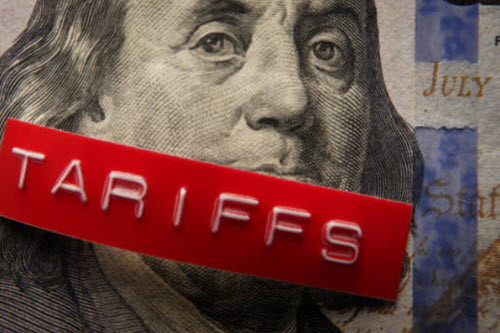
Impact on Business Valuations Tariffs have long served as a tool for national governments to protect domestic industries, correct trade imbalances, or as leverage in international negotiations. This article explores the cascading impacts of recent U.S. tariffs and reciprocal trade barriers on U.S. goods and services. Tariffs have long served as a tool for national governments to protect domestic industries, correct trade imbalances, or as leverage in international negotiations. The United States, as the world’s largest economy, holds a central role in shaping global trade norms. In recent years, particularly following the 2016 presidential election, the U.S. adopted a more…
-
-
A now record-setting run of U.S. economic growth enters its 121st month on Monday, sustained by a decade of low interest rates and massive Federal Reserve intervention that helped put 22 million people back to work. To read the full article in Reuters, click: As U.S. Expansion Notches Record, Recovery May Have Only Just Begun.
-
Women control about $14 trillion in assets in the U.S., which is comparable to the gross domestic products of China and India combined—and they are under-served by financial advisors. The industry needs to hone its services to reflect the growing power of female clients. To read the full article in Financial Planning, click: Rich Women Increasingly Call the Shots, Wealth Management Execs Say.
-
The financial crisis of 2008 may have started in the U.S. banking sector but it went on to unleash the deepest global recession since the Great Depression. To read the full article in World Economic Forum, click: An Economist Explains What Happens if There is Another Financial Crisis.
-
Business economists have grown a little less optimistic about the outlook for the U.S. economy as a result of U.S. trade policies. The National Association of Business Economists reports that its survey of 45 professional economic forecasters now projects a median 2.8% growth in real GDP from Q4 2017 to Q4 2018, down from 2.9% three months ago. To read the full article in Think Advisor, click: A Mixed Outlook for the U.S. Economy.
-
Small Business Borrowing Falls to Lowest Point Since October Small business borrowing fell in April to its lowest point since October and was down five percent from April 2016, according to the Thomson Reuters/PayNet Small Business Lending Index. The drop is seen as an indicator of potentially slowing economic growth. To read the full article in Reuters, click: U.S. Small Business Borrowing Drops to Six Month Low.
-
Boosted by solid consumer spending and improving international trade, the expansion of the U.S. economy rose to 2.9% in the third quarter, the Commerce Department said. Nelson Schwarts reports that economists said the biggest quarterly gain in two years will probably be enough to persuade the Federal Reserve to raise interest rates in December. To read the full article in The New York Times, click: U.S. Economy Grew 2.9% in 3rd Quarter, Picking Up the Pace.
-
Brexit Seen Delivering Brutal but Brief Blow to UK Economy The UK economy is on “a very different path” from that of a few months ago, with business investment and consumer spending due for a short, sharp post-Brexit shock, according to a forecast by the EY Item Club. The organization has slashed its UK growth forecast for 2016 to 0.4% from 2.6% and predicts the pound will be down 15% by year’s end. Gwyn Topham discusses the issue. To read the full article in The Guardian, click: UK Economy Must Endure ‘Short, Sharp Shock’ After Brexit Vote.
-
Jeff K. Davis, managing director of Mercer Capital’s Financial Institutions Group, attended Creditflux’s private credit conference in New York a couple of days before the Brexit vote. He explains that there was not much concern mentioned among mostly U.S. credit investors about it as a market or economic catalyst; nor was there much concern expressed about an aging credit cycle. To read the full article in Mercer Capital’s Financial Reporting Blog, click: Income Post-Mortem and Coupon Clipping. This article is republished from Mercer Capital’s Financial Reporting Blog. It is reprinted with permission. To subscribe to the blog, visit: http://mercercapital.com/category/financialreportingblog/.
-
Economic growth in the U.S. registered a frail 0.5% in the first quarter; the worst showing since Q1 of 2014. A strong dollar and a drive by businesses to draw down inventories contributed, as did slow investment due to low oil prices. However, Lucia Mutikani discusses that analysts are optimistic the pace will pick up as some stifling factors fade in coming quarters. To read the full article in Reuters, click: U.S. Economy Stalls in First Quarter as Activity Weakens Broadly.
-
Are We Heading Towards the Next Financial Crisis? (Part II of II) In this second part of the two-part article, the author, a valuation professional and trained economist, shares his thoughts on whether we are headed towards another financial crisis. Here, he shares his views on the size of the U.S. debt, low interest rates and whether the low interest environment is sustainable, and what he sees are solutions to the U.S. economic problems. (The views expressed in this article are solely those of the author; QuickRead invites its readers to respond or submit an article of their own on…
-
With the rise of technology and professional service firms, the U.S. marketplace is shifting from one which supplies goods to one which supplies ideas. Taryn E. Burgess, financial analyst with Mercer Capital, explains there is a growing gap in the balance sheet reflecting this shift from physical assets to intangible ideas. To read the full article in Mercer Capital’s Financial Reporting Blog, click: Our Economy Has Changed. Should Our Accounting Standards? This article is republished from Mercer Capital’s Financial Reporting Blog. It is reprinted with permission. To subscribe to the blog, visit: http://mercercapital.com/category/financialreportingblog/.
-
Are We Heading Towards the Next Financial Crisis? (Part I of II) In this two-part article, the author, a valuation professional and trained economist, shares his thoughts on whether we are headed towards another financial crisis. (The views expressed in this article are solely those of the author, QuickRead invites its readers to respond or submit an article of their own on this important topic.)
-
Part 1: Find Industry and Location-Specific Data Courts standards require that damages analysis results be within “reasonable certainty”, and objective rather than speculative. And while the terms “reasonable certainty” and “speculative” are more terms of art than science, given these standards, it is of vital importance to analyze all relevant factors to the extent permitted by the best data available. And it is the responsibility of the damages expert to present an analysis that is both reasonably certain and objective by engaging in reasonable effort to request and/or research the best data available. The expert that is unable to isolate…
-
While most don’t see a benefit to speaking a second language in their personal or professional life, the increasing diversity of large cities and unexpected international elements in business deals is stressing its importance. Even though you may not remember any of your high school Spanish or German, it’s never too late start again, if for no other reason than the financial incentive involved. The Economist joined forces with scholars at the Massachusetts Institute of Technology (MIT) to determine the value of languages; which pay the biggest dividends with regard to education, GDP and compounding salary interest. You’ll be surprised…
-
According to the US Bureau of Economic Analysis, “research and development” (R&D) are now considered a fixed investment. The report, released last month, contains GDP figures categorizing R&D with this distinction. R&D now joins software in a new category labeled “intellectual property products”. While some see the change as only affecting a small number of economists, others see the move as bridging a gap between digital economy and the way analysts account for it. McKinsey & Company provide a solid review of what the change means here. “[Intangible digital capital assets] are manifold: the unique designs that engage large…
-
Visualizing the Middle Market The Middle Market not only accounts for a third of private sector GDP and jobs, but over the last four years it’s been leading the way in terms of viability, resilience and growth, according to a new study from GE Capital. When it comes to economic development and employment growth, people tend to focus on either small local businesses or large multi-national corporations. But what about the gap in the middle? To learn more, GE Capital partnered with The Ohio State University Fisher College of Business to conduct the largest-ever study of American mid-market businesses. A new…